
 leaveletandClaude Opus 4.8
864b1c808e
leaveletandClaude Opus 4.8
864b1c808e
On a radix miss, reload the evicted-but-L3-durable suffix from disk into L2 + insert a fresh
radix node, holding the triggering request until then (mirrors the storage-prefetch hold, which
is disabled under CP). The reloaded prefix re-enters the radix as a normal L2 node, so the
existing load_back serves L2->L1 -- no new device path.

Design (docs_internal/cp_hicache_l3_phase3_impl_design.md §9, refined for minimal sync):
- ENTRY (scheduler _prefetch_kvcache, enable_cp_l3 branch): mark a miss-with-suffix as a reload
  candidate (rank-uniform: requests are broadcast). cp_l3_reload_lookup computes the suffix's
  full-page content hashes -- the SAME SHA chain spill wrote (compute_node_hash_values).
- RESERVE + ADMIT fold into the existing per-tick _drain_l3_control_queues MINs -- ZERO new
  collectives: the candidates' per-rank exists_prefix counts ride the qsize MIN vector -> a
  rank-uniform agreed count C (this reconciles the async-LMDB read-skew); reload-ack oks ride the
  durable ok-AND. Reserve is then collective-free (deterministic evict-to-fit mirroring
  _reserve_write_cp_shared_l2_evict_to_fit); the request waits non-blocking in waiting_queue
  (check_cp_l3_reload_progress skip) and is admitted + re-matched the SAME tick the reload lands
  (check_hicache_events runs before batch formation). CP-aware insert only on a still-clean attach
  (else abort+recompute). Capped (cp_l3_reload_max_inflight) + content-key deduped (piggyback).

EAGLE/bigram (opus-studied, PROVABLY correct -- not deferred): the radix key is bigram-converted
over the whole request, and convert_to_bigram_key(fill_ids[M:]) == bigrams(fill_ids)[M:] exactly
(the boundary bigram belongs to the matched prefix), so the bigram-converted suffix hashes
reproduce node.hash_value. Verified vs source + a new slice-identity regression test.

Opus review (FIX-THEN-SHIP, no CRITICAL; the 4 crash surfaces -- MIN-vector shape, read-skew,
attach-anchor, placement-digest -- traced clean) + independently re-verified; fixes folded:
- M1: cp_l3_release_request clears reload state on request abort/timeout/preempt (no leak).
- H1: rank-uniform per-op TTL bound releases a held request if its reload op never acks (the
  default SGLANG_REQ_WAITING_TIMEOUT is off); the reservation frees safely at the (late) ack.
- L1: fail-soft anchor guard at insert (re-derive the first suffix hash from lhn's live hash).
- empty-waiters reload aborts (frees L2) instead of inserting an unrequested node.

Imports hoisted to top-level (get_hash_str -- hicache_storage is a leaf module, no cycle;
convert_to_bigram_key already top-level), no inline imports. py_compile clean; 54 L3 unit tests
green. Reload triggering (submit_reload/exists_prefix/free_object) now wired (was write-only).

Co-Authored-By: Claude Opus 4.8 (1M context) <noreply@anthropic.com>







Blog | Documentation | Roadmap | Join Slack | Weekly Dev Meeting | Slides
News
- [2026/02] 🔥 Unlocking 25x Inference Performance with SGLang on NVIDIA GB300 NVL72 (blog).
- [2026/01] 🔥 SGLang Diffusion accelerates video and image generation (blog).
- [2025/12] SGLang provides day-0 support for latest open models (MiMo-V2-Flash, Nemotron 3 Nano, Mistral Large 3, LLaDA 2.0 Diffusion LLM, MiniMax M2).
- [2025/10] 🔥 SGLang now runs natively on TPU with the SGLang-Jax backend (blog).
- [2025/09] Deploying DeepSeek on GB200 NVL72 with PD and Large Scale EP (Part II): 3.8x Prefill, 4.8x Decode Throughput (blog).
- [2025/09] SGLang Day 0 Support for DeepSeek-V3.2 with Sparse Attention (blog).
- [2025/08] SGLang x AMD SF Meetup on 8/22: Hands-on GPU workshop, tech talks by AMD/xAI/SGLang, and networking (Roadmap, Large-scale EP, Highlights, AITER/MoRI, Wave).
More
- [2025/11] SGLang Diffusion accelerates video and image generation (blog).
- [2025/10] PyTorch Conference 2025 SGLang Talk (slide).
- [2025/10] SGLang x Nvidia SF Meetup on 10/2 (recap).
- [2025/08] SGLang provides day-0 support for OpenAI gpt-oss model (instructions)
- [2025/06] SGLang, the high-performance serving infrastructure powering trillions of tokens daily, has been awarded the third batch of the Open Source AI Grant by a16z (a16z blog).
- [2025/05] Deploying DeepSeek with PD Disaggregation and Large-scale Expert Parallelism on 96 H100 GPUs (blog).
- [2025/06] Deploying DeepSeek on GB200 NVL72 with PD and Large Scale EP (Part I): 2.7x Higher Decoding Throughput (blog).
- [2025/03] Supercharge DeepSeek-R1 Inference on AMD Instinct MI300X (AMD blog)
- [2025/03] SGLang Joins PyTorch Ecosystem: Efficient LLM Serving Engine (PyTorch blog)
- [2025/02] Unlock DeepSeek-R1 Inference Performance on AMD Instinct™ MI300X GPU (AMD blog)
- [2025/01] SGLang provides day one support for DeepSeek V3/R1 models on NVIDIA and AMD GPUs with DeepSeek-specific optimizations. (instructions, AMD blog, 10+ other companies)
- [2024/12] v0.4 Release: Zero-Overhead Batch Scheduler, Cache-Aware Load Balancer, Faster Structured Outputs (blog).
- [2024/10] The First SGLang Online Meetup (slides).
- [2024/09] v0.3 Release: 7x Faster DeepSeek MLA, 1.5x Faster torch.compile, Multi-Image/Video LLaVA-OneVision (blog).
- [2024/07] v0.2 Release: Faster Llama3 Serving with SGLang Runtime (vs. TensorRT-LLM, vLLM) (blog).
- [2024/02] SGLang enables 3x faster JSON decoding with compressed finite state machine (blog).
- [2024/01] SGLang provides up to 5x faster inference with RadixAttention (blog).
- [2024/01] SGLang powers the serving of the official LLaVA v1.6 release demo (usage).
About
SGLang is a high-performance serving framework for large language models and multimodal models. It is designed to deliver low-latency and high-throughput inference across a wide range of setups, from a single GPU to large distributed clusters. Its core features include:
- Fast Runtime: Provides efficient serving with RadixAttention for prefix caching, a zero-overhead CPU scheduler, prefill-decode disaggregation, speculative decoding, continuous batching, paged attention, tensor/pipeline/expert/data parallelism, structured outputs, chunked prefill, quantization (FP4/FP8/INT4/AWQ/GPTQ), and multi-LoRA batching.
- Broad Model Support: Supports a wide range of language models (Llama, Qwen, DeepSeek, Kimi, GLM, GPT, Gemma, Mistral, etc.), embedding models (e5-mistral, gte, mcdse), reward models (Skywork), and diffusion models (WAN, Qwen-Image), with easy extensibility for adding new models. Compatible with most Hugging Face models and OpenAI APIs.
- Extensive Hardware Support: Runs on NVIDIA GPUs (GB200/B300/H100/A100/Spark), AMD GPUs (MI355/MI300), Intel Xeon CPUs, Google TPUs, Ascend NPUs, and more.
- Active Community: SGLang is open-source and supported by a vibrant community with widespread industry adoption, powering over 400,000 GPUs worldwide.
- RL & Post-Training Backbone: SGLang is a proven rollout backend used for training many frontier models, with native RL integrations and adoption by well-known post-training frameworks such as AReaL, Miles, slime, Tunix, verl and more.
Getting Started
Benchmark and Performance
Learn more in the release blogs: v0.2 blog, v0.3 blog, v0.4 blog, Large-scale expert parallelism, GB200 rack-scale parallelism.
Adoption and Sponsorship
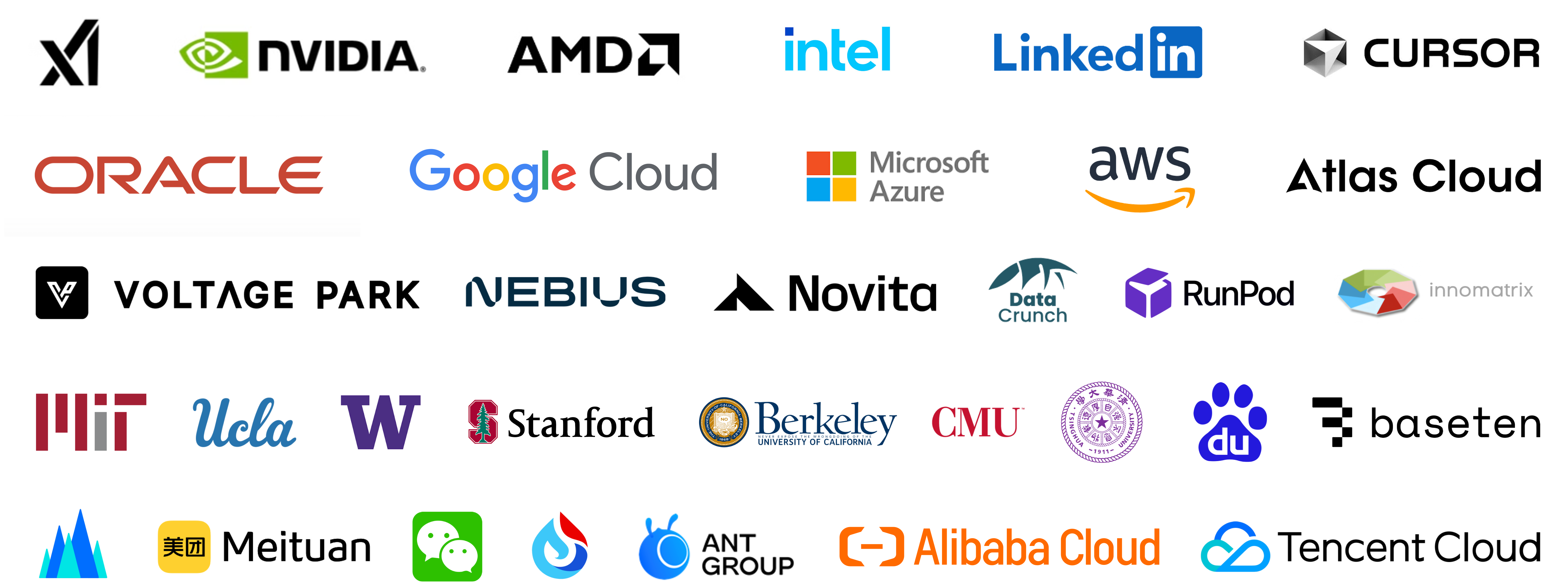
SGLang has been deployed at large scale, generating trillions of tokens in production each day. It is trusted and adopted by a wide range of leading enterprises and institutions, including xAI, AMD, NVIDIA, Intel, LinkedIn, Cursor, Oracle Cloud, Google Cloud, Microsoft Azure, AWS, Atlas Cloud, Voltage Park, Nebius, DataCrunch, Novita, InnoMatrix, MIT, UCLA, the University of Washington, Stanford, UC Berkeley, Tsinghua University, Jam & Tea Studios, Baseten, and other major technology organizations across North America and Asia. As an open-source LLM inference engine, SGLang has become the de facto industry standard, with deployments running on over 400,000 GPUs worldwide. SGLang is currently hosted under the non-profit open-source organization LMSYS.
Contact Us
For enterprises interested in adopting or deploying SGLang at scale, including technical consulting, sponsorship opportunities, or partnership inquiries, please contact us at sglang@lmsys.org
Acknowledgment
We learned the design and reused code from the following projects: Guidance, vLLM, LightLLM, FlashInfer, Outlines, and LMQL.